
The road to digital transformation for telecom operators has a name: the TM Forum’s Open Digital Architecture (ODA). With its focus on cloud-native agility, standardization, and Open APIs, ODA lays out a clear blueprint for the future. But there’s a catch—and it’s one every telco knows all too well.
The Legacy Barrier to ODA
Most Communication Service Providers (CSPs) don’t operate in a greenfield. They run mission-critical services on legacy OSS/BSS stacks that are deeply entrenched in operations, some dating back decades. These systems are rigid, siloed, and incompatible with the open, modular architecture that ODA demands.
The result? CSPs are caught in a bind—unable to replace their legacy investments overnight, but equally unable to fully adopt new ODA-compliant capabilities without costly, high-risk replatforming.
Enter Symphonica: Enable ODA for Everything
Symphonica changes the game by enabling ODA-fication for any OSS or BSS component, no matter how old or proprietary. It does this by creating an ODA-compliant abstraction layer—using no-code workflows and AI-powered connectors—that bridges legacy systems with modern architectures.
Think of it as interoperability, on-demand:
- Expose legacy functionality through TMF Open APIs.
- Orchestrate complex cross-domain processes with zero custom code.
- Modernize incrementally, without operational disruption.
This isn’t theory. It’s how Symphonica is already helping tier-1 and tier-2 operators accelerate their ODA journey, without ripping out their OSS.
Trigger any Workflow with any ODA APIs
Symphonica’s no-code orchestration isn’t just powerful—it’s precise, standards-based, and fully aligned with TM Forum Open APIs. With out-of-the-box support for dozens of TMF APIs, including TMF639 (Resource Inventory), TMF640 (Service Activation), TMF633 (Service Catalog), and more, you can trigger any workflow based on ODA-standard interactions—without writing a single line of code.
This process is as simple as drag, drop, and deploy:
1. Create a New Workflow
Start by launching a new workflow from Symphonica’s visual process designer. Choose from a range of control elements, tasks, and API actions to define your orchestration logic. This interface is built for operations, not just developers, so your teams can move fast without depending on IT or external integrators.

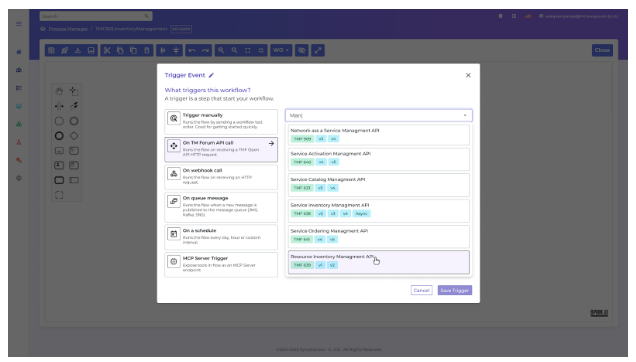
2. Choose an ODA API Trigger
Select from supported TMF Open APIs to trigger the workflow. Whether the trigger is a TMF639 Inventory Management call, a webhook, a queue message, or a timed schedule, Symphonica makes it easy to integrate real-world telecom events into your orchestration logic. Here, the user selects TMF639—an inventory API call—as the workflow trigger.
3. Design the Workflow to ODA-ficate a Legacy System
Use no-code blocks to define the logic to make any legacy system ODA compliant. In this example:
- The trigger sets initial context variables.
- A conditional path handles different request types (GET/POST).
- The system pulls and transforms device data using legacy logic wrapped inside modular tasks.
- Final actions log, route, or push data to modern external inventory systems—exposing the legacy as TMF639-compliant.
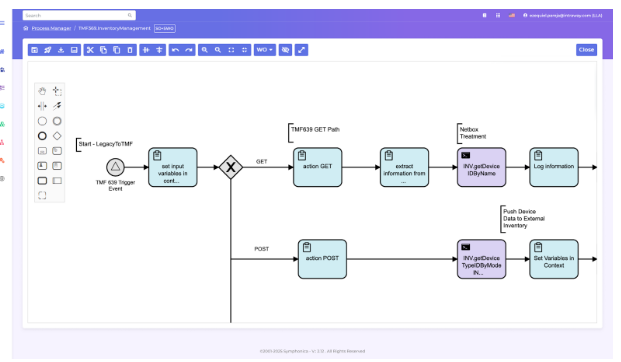
This is true ODA-fication: you’re not just consuming TMF APIs, you’re enabling them by wrapping and orchestrating legacy functionality to behave like a modern, standards-compliant microservice.
Conclusion: Modernize Without Replacing
Digital transformation doesn’t have to be disruptive. With Symphonica, CSPs can:
- Preserve legacy system investments
- Adopt TM Forum standards without replatforming
- Accelerate automation, orchestration, and innovation
- Future-proof operations for autonomy and agility
This is the practical path to ODA. Not a forklift upgrade. Not a multi-year black box integration. But a modular, incremental modernization strategy—powered by no-code, built for telco operations, and aligned to the ODA vision.